
.png)
Retail Real Estate Trends 2026: Retail Isn’t Moving as One Market in 2026
- Amy Brown
- Apr 16
- 5 min read

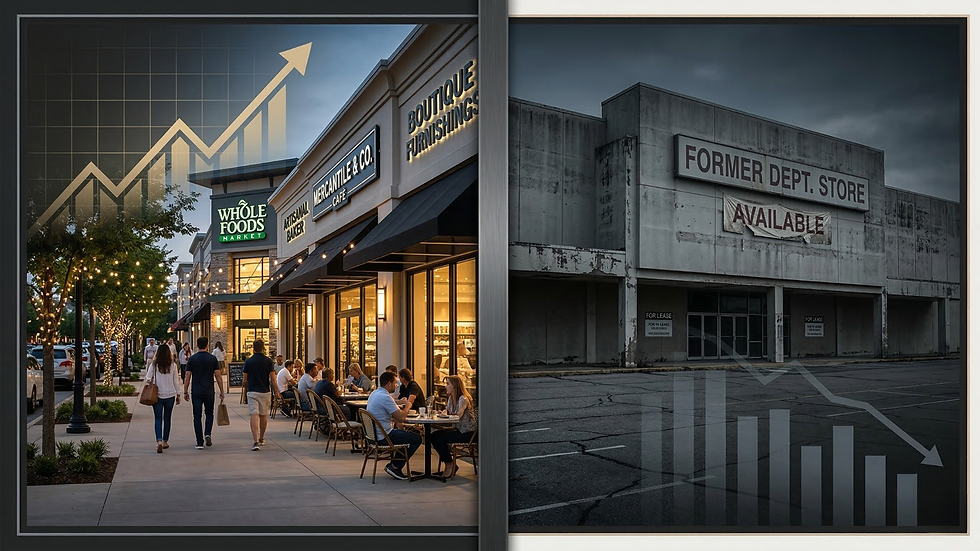
One of the biggest mistakes in commercial real estate right now is talking about retail as if it is behaving like a single asset class.
It is not.
The retail market heading into 2026 shows key divergences, highlighting critical retail real estate trends 2026, but the strength is uneven across formats. Tight vacancy, limited new supply, and faster leasing cycles are creating real momentum in some formats. At the same time, large-format boxes, bankruptcy-driven space givebacks, and location-specific softness are reminding owners and investors that broad headlines still do not replace disciplined underwriting.
That is the real story: retail is not simply “back.” It is separating. The market is rewarding convenience, daily-needs traffic, adaptability, and strong trade-area fundamentals — while putting more pressure on oversized, less flexible, or operationally mismatched space.
Tight Vacancy in Retail Real Estate Trends 2026 — But It Is Not Universal
Retail fundamentals remain healthier than many expected. eXp Commercial’s recent 2026 retail outlook, citing CoStar analysis, notes vacancy is holding around 4%, largely because new construction has remained very limited relative to pre-pandemic norms. That limited inventory growth has helped keep supply and demand in unusually tight alignment and has preserved landlord leverage across many submarkets.
But low vacancy alone does not make every retail asset equal.
The better interpretation is that the market has become more selective. Space that is well-located, properly sized, and aligned with how consumers actually shop is leasing and repricing differently than space that depends on outdated assumptions, weak co-tenancy, or overly optimistic repositioning stories. In other words, tight market data is supportive — but it is not a substitute for asset-level realism.
Small-format retail is benefiting from how consumers actually live
One of the most important trends in retail today is the continued strength of smaller-format space, especially in neighborhood and grocery-anchored environments.
That is not accidental. Grocery-anchored retail continues to stand out because it captures recurring traffic, service-based spending, and daily-needs behavior that is much harder to displace. JLL reported grocery-anchored retail vacancy at 3.5% as of Q4 2024, with less than 100,000 square feet of net deliveries for the second year in a row. It also found grocery-anchored rents rose 3.1% year over year, the strongest annual rent growth among retail subtypes it tracked.
eXp Commercial’s 2026 trend piece also points to exceptionally tight availability for spaces under 5,000 square feet, which is exactly where many service, food, beauty, medical-adjacent, and convenience-based users want to be. That matters because it reinforces a broader point: much of retail’s current strength is being driven by formats that fit modern consumer patterns rather than legacy store footprints.
Large-format space is where the market becomes more complicated
This is where surface-level commentary tends to fail.
While overall retail sentiment has improved, large-format space continues to face a different set of challenges. eXp Commercial highlighted that much of the rise in availability is concentrated in boxes above 10,000 square feet, driven in part by bankruptcies and downsizing from names such as Big Lots, Party City, and Macy’s. ICSC similarly noted that much of the quality space returning to market has been tied to vacancies from distressed or downsizing retailers, including Big Lots, CVS, Macy’s, Conn’s, and others.
That does not mean large boxes are inherently bad assets. It means they require better questions.
Can the box be subdivided efficiently? Is the site still relevant for today’s users? Does the trade area support alternative demand? Will the retrofit cost overwhelm the lease-up story? Is there enough parking, access, visibility, and surrounding draw to reposition the space in a durable way?
In 2026, those are not secondary questions. They are the underwriting. The wrong box in the wrong corridor can sit far longer than market averages suggest, even while smaller-format retail across town remains highly competitive.
Faster leasing velocity is a signal — but not a shortcut
Another data point worth paying attention to is leasing speed. According to eXp Commercial’s 2026 retail summary, average time to lease has compressed to roughly seven months, below a longer-term historical norm closer to ten months. That is meaningful because it reflects genuine demand pressure in tighter formats and better-located centers.
But faster lease velocity should not be read as permission to get lazy.
The real opportunity is not just moving space faster. It is understanding which spaces are moving faster, why they are moving, and whether that demand is durable. Lease velocity is powerful when paired with tenant-quality analysis, local demand mapping, co-tenancy strategy, and a realistic view of what concessions or buildout requirements will still be necessary. A deal moving quickly is not always the same thing as a deal moving well.
The next wave of winners will be format-specific and location-specific
Retail in 2026 is being shaped by more than vacancy and leasing data. CBRE points to broader structural forces including demographic shifts, the importance of vibrant mixed-use districts, the strength of dense suburban clusters, and the fact that e-commerce risk varies sharply by tenant category and market. It also estimates the U.S. is under-retailed by approximately 200 million square feet, or about 5% of total retail stock, with need concentrated more heavily in certain growth markets.
That matters because it reinforces a core CRE truth: not all retail demand is interchangeable.
Some centers are benefiting from population growth, evolving household patterns, and tenant categories that complement how people now shop, dine, and access services. Others are fighting format obsolescence, weaker traffic patterns, or tenant mixes that are more vulnerable to digital substitution. The difference between those two outcomes is where experience, market knowledge, and strategy still matter.
What smart owners and investors should be asking now
The strongest retail decisions in this market are not being made by people who are simply repeating that vacancy is low.
They are being made by people asking sharper questions: Is this center aligned with recurring consumer behavior? Is the available space the kind of space tenants are actually chasing? Does the tenant mix create resilience or just occupancy? If space comes back, how hard is it really to re-lease? Is this asset benefiting from real demand, or just from a temporary lack of supply?
That is why retail deserves a more nuanced conversation in 2026. The sector is healthier than many people assumed it would be, but it is not moving uniformly. The most durable opportunities are increasingly concentrated in assets that combine the right format, the right location, the right traffic drivers, and the right leasing strategy.
Final thought
Retail is not dead. It is not universally booming either.
It is sorting itself.
And in this market, the edge belongs to owners, investors, and advisors who understand that the real story is no longer whether retail is strong in the aggregate. It is which retail assets are positioned to hold pricing power, lease efficiently, and remain relevant as consumer behavior continues to evolve.
Retail fundamentals may look strong at the headline level, but asset-level performance is becoming more selective. If you are evaluating a retail property, lease-up strategy, acquisition, or repositioning opportunity, the details matter.


Comments